




Beam Seating Buyer's Guide: Airport-Style Seating for Any Waiting Area
Apr 2nd 2026
Beam seating has one failure mode that individual chairs don't: it can't be rearranged after installation. Every other characteristic is an upgrade for high-traffic public spaces. A beam row bolted into a terminal floor processes 400 daily occupants without drifting, developing a wobbly base, or ending up in a different room. The whole unit wipes down in one pass.
That fixed-layout tradeoff is why airports, courthouses, and hospital lobbies spec beam seating instead of individual chairs, and why buyers who've ordered it once tend to order it again.
Getting the order right, though, takes more planning than a standard chair purchase. Wrong beam length means a re-order. Wrong upholstery in a clinic means reupholstering in 18 months. Wrong vendor and the chairs arrive eight weeks after your facility opens.
What Beam Seating Is
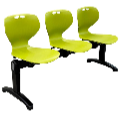
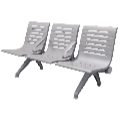
Beam seating mounts individual seat units onto a shared steel beam that runs the length of the row. The beam connects to the floor through legs or floor glides. Each seat is fixed in place.
That construction separates beam seating from ganged chairs, which link individual chairs with a small bracket. Ganged chairs can be unlinked and moved. Beam units can't. In environments where hundreds of people cycle through daily, ganging brackets work loose over months of heavy use. The shared steel frame holds.
Where It Gets Specified
Airports and transit terminals are the obvious application, but beam seating now gets specified across a wide range of institutional settings:
- Federal, state, and county government waiting rooms
- Hospital lobbies and outpatient clinic reception areas
- Emergency department waiting areas
- Courthouses, DMV offices, and social services centers
- University student services and financial aid offices
- Corporate reception lobbies with high daily visitor volume
- Bus and train station waiting areas
What these facilities share is sustained high occupancy and no budget for the maintenance problems individual chairs create. Chairs that scatter, wobble, or migrate to other rooms are a daily nuisance in a 50-person waiting room. In a 500-person terminal, they're a safety issue.
How to Size the Order
Measure linear footage before counting seats
Most beam seat units are 20 to 22 inches wide per seat. With armrests factored in, the planning benchmark is 18 to 20 inches of usable width per person. A 12-foot wall run fits a 6-seat configuration. A 20-foot open floor area fits a 10-seat run, or two 5-seat runs with a gap for a wheelchair clearance zone.
Sketch the room to scale before configuring. Structural columns and alcoves that don't appear in the sketch create problems on installation day.
Mix lengths to match the floor plan
Manufacturers produce beam seating in 2-, 3-, 4-, 5-, and 6-seat configurations, with some offering 8-seat units. Ordering a single length throughout a waiting room looks clean on a spreadsheet. Corner alcoves, angled walls, and irregular room dimensions rarely divide evenly into one configuration.
Mixing 3- and 4-seat runs gives the installation crew flexibility to fill odd spans without cutting or returning units. For large open-plan spaces with consistent wall lengths, 6-seat units are the efficient choice.
Upholstery
Fabric vs. vinyl
Beam seat pads and backs come in fabric or vinyl. Fabric is more comfortable for waits that run longer than 20 minutes, but it absorbs stains and shows wear faster under daily traffic. Vinyl wipes clean and holds up in settings that require regular sanitizing.
For healthcare facilities and government waiting rooms, specify antimicrobial vinyl. The per-seat cost difference is small. Replacing an entire installation's upholstery two years early is not.
Tablet arms
Some beam configurations include fold-down tablet arms. They're worth specifying in DMV offices, licensing centers, and any facility where visitors fill out forms while they wait. Ask whether the tablet arm mounts on the beam frame or the seat unit. Frame-mounted tablets handle load without flexing. Seat-mounted tablets wobble under pressure and wear out faster.
Floor Mounting Options
Beam seating comes in two mounting styles. Anchored models bolt through the base into the floor and are standard for transit terminals, courthouses, and any facility where permanent installation is required. Floor glide models sit on wide rubber or nylon feet and can be repositioned without drilling, making them the better fit for corporate lobbies and facilities that reconfigure seasonally.
For polished concrete, terrazzo, or tile surfaces, confirm the glide material before ordering. Hard plastic glides scratch finished floors. Felt and rubber don't.
ADA Compliance
The ADA requires clear floor space for wheelchair users adjacent to fixed seating. The standard is 30 by 48 inches of unobstructed floor space beside each accessible position. In most public accommodations, one accessible space per four fixed seats is the minimum.
Some beam models include a built-in end cap that designates a wheelchair position without requiring a separate freestanding chair. Confirm your floor plan meets the required ratio before the installation. Not after.
Vendor Questions Worth Asking
Not every vendor who lists beam seating stocks it. Many carry it as a catalog item and place the factory order when a buyer pays. Lead times on those manufacturer orders run 4 to 8 weeks. For installations with hard deadlines — facility openings, renovation completions, fiscal year spending cutoffs — that's not a workable timeline.
Before the order is placed, confirm:
- The specific configuration is in the vendor's warehouse, not on a manufacturer order
- The ship date and transit time to your location, in writing
- Whether your organization can pay by purchase order
- What freight delivery covers and whether inside delivery is included
- Whether replacement parts are stocked for the model
For orders above 10 seats, request a sample unit first. Seat depth, back height, and cushion density vary between manufacturers and don't appear in spec sheets.
Beam Seating at InStockChairs
InStockChairs stocks beam seating in its own warehouse in Eden Prairie, Minnesota. The customer service team works on-site and can confirm inventory before an order is placed. Corporate and government accounts can purchase by purchase order. Shipping is free to all 48 contiguous states on orders of any size.
For buyers working through a floor plan and uncertain whether a configuration will fit, the customer service team has processed enough installations to spot sizing problems before the order ships.