




Cost-Per-Seat Budgeting for Call Centers: How to Balance Durability with Price
Apr 7th 2026
Call center seating fails on a different schedule than standard office seating. A chair rated for single-shift, single-user occupancy will last 5 to 7 years in a private office. Put the same chair on a 24-hour rotation with three users per seat and it lasts 18 months before the cylinder fails or the mesh sags past the point of adjustment.
Operations managers who budget by unit price miss this. The $180 chair that gets replaced every 18 months costs more over a 5-year period than the $350 chair rated for continuous multi-shift use. The unit price is visible at purchase. The replacement cycle isn't.
Why Standard Office Chairs Fail in Call Center Environments
The ANSI/BIFMA test for a commercial office chair assumes single-occupancy use, 40 hours per week. A 24-hour call center with two or three shifts puts 80 to 120 hours of use per week on each seat. The tilt mechanism, cylinder, and caster wheels accumulate fatigue cycles at two to three times the rate of a standard office environment.
The components that fail first under this load profile are predictable. Pneumatic cylinders lose pressure and drop to the lowest position. Mesh backs stretch and lose the tension that provides lumbar support. Caster wheels flatten on one side from sustained directional load. Armrests crack at the bracket connection under repeated weight transfer.
A chair designed for single-shift use has these components engineered to a price point that works for 40 hours a week. Three shifts at 8 hours each, seven days a week, is four times that load.
How to Calculate Real Cost-Per-Seat
The formula
Divide the unit price of the chair by its expected usable lifespan in years. The result is annual cost per seat. Compare that figure across models before the budget is set.
Example: A $180 consumer-grade chair lasting 18 months in a call center environment runs $120 per seat per year. A $320 BIFMA-standard 24/7 chair lasting 5 years in the same environment runs $64 per seat per year. The cheaper chair costs 88 percent more per year when replacement cycles are factored in.
Replacement cycle estimates by chair type
These are real-world ranges, not manufacturer claims:
- Consumer-grade chairs in 24/7 use: 12 to 18 months before components fail
- Standard commercial chairs (single-shift rated) in 24/7 use: 2 to 3 years
- 24/7-rated chairs that meets BIFMA standards: 4 to 6 years
- Heavy-duty 24/7 chairs with 400-plus pound capacity: 5 to 7 years
The BIFMA HPC standard (High Performance Contract) is the specific certification to look for in multi-shift environments. It tests beyond the base BIFMA certification with higher cycle counts and load requirements.
Specifications That Matter for 24/7 Use
Cylinder and base construction
The pneumatic cylinder is the first component to fail in high-rotation seating. In 24/7 chairs, look for cylinders rated for continuous commercial use, not just listed weight capacities. Class 4 cylinders are standard for single-shift commercial chairs. Chairs rated for 24/7 use carry reinforced cylinders designed for higher cycle loads.
The base should be aluminum or heavy-gauge steel. Plastic bases, common in mid-range commercial chairs, crack under sustained load. For a seat with three users rotating through 8-hour shifts, the base is a structural component.
Seat construction
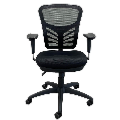
Mesh seats and backs breathe well in sustained-use environments, which is why they dominate call center seating. The problem is mesh tension. Standard mesh loses tension faster under 24/7 use because the material fatigues under directional load. Multi-layer mesh or high-density elastic mesh holds tension longer.
For foam seats, high-density foam resists compression and holds its shape over time where standard foam breaks down and bottoms out. A seat pan that bottoms out after 12 months means users are sitting on the support structure under the foam. For call center use, specify foam rated at a minimum density of 2.0 pounds per cubic foot. Most product listings don't include this figure. Ask for it, or ask the vendor which of their models are specified for 24/7 environments.
Weight capacity and frame
A call center serves a workforce across a wide range of body types. Ordering all seating at a standard 250-pound capacity means some percentage of the staff is sitting in chairs rated below their weight, which accelerates failure and creates a liability exposure.
For a mixed workforce, the standard approach is to order the majority of seats at 300 to 350-pound capacity and 10 to 15 percent of seats at 400-plus pound capacity. This covers the full workforce without over-specifying every seat at the higher price point.
Where Call Center Seating Budgets Go Wrong
Approving the budget in unit costs, not total lifecycle costs
Finance and procurement teams review unit prices. They approve $180 versus $320 per chair and select the lower number. The operations manager who will deal with 40 failed cylinders in 18 months isn't in that meeting. Build the lifecycle cost calculation before the budget review, not after.
Buying from a vendor who doesn't stock the chairs
Call centers replace seating on an ongoing basis as chairs fail. A vendor who holds inventory can ship replacement chairs within the same week they're needed. A vendor who drop-ships from a manufacturer requires 4 to 8 weeks per replacement order. For a 100-seat call center replacing 15 to 20 chairs per year, that gap creates a real staffing and ergonomics problem.
Specifying by price tier instead of certification
'Commercial grade' is a marketing term with no standard definition. BIFMA standards are a testable specification. The difference matters: a chair marketed as commercial grade at $200 may have been tested to the residential standard. A chair that meets BIFMA standards at $280 has passed independent testing for commercial load cycles. For call center procurement, certification should be a hard specification requirement, not a preference.
Not accounting for armrest wear
Armrests take more abuse in call center environments than most buyers anticipate. Users rest their forearms on armrests for 6 to 8 hours per shift. The padding compresses and the surface material cracks under sustained use. Chairs with replaceable armrest pads extend the usable life of the seat without requiring a full replacement.
Building a 5-Year Seating Budget
For a 100-seat call center, a reasonable 5-year seating budget using 24/7-rated commercial chairs at $300 to $350 per unit covers:
- Initial purchase: 100 chairs at $325 average = $32,500
- Year 2 to 3 replacements (10 percent failure rate): 10 chairs = $3,250
- Year 4 to 5 replacements (15 percent failure rate): 15 chairs = $4,875
Total 5-year cost: $40,625, or $81 per seat per year.
The same center using $180 consumer-grade chairs with an 18-month replacement cycle replaces the full inventory 3.3 times over 5 years: $180 x 100 x 3.3 = $59,400. That's 46 percent more than the 24/7-rated option, plus the operational cost of managing three full replacement cycles.
What to Ask When Sourcing Call Center Chairs
Before placing a call center seating order, confirm these with the vendor:
- Does the chair meet BIFMA standards for commercial 24/7 use?
- What is the rated occupancy: single-shift or 24/7 continuous use?
- Are replacement parts (cylinders, armrests, casters) available for this model?
- Does the vendor ship from in-house stock, or does the order go to the factory on a lead time?
- Does the vendor accept purchase orders from corporate or government accounts?
InStockChairs carries 24/7-rated commercial chairs for multi-shift environments, ships from in-house inventory in Eden Prairie, Minnesota, and accepts purchase orders from corporate and government buyers. Free shipping applies to all orders in the 48 contiguous states.