



Stacking Chairs vs. Folding Chairs: What's the Difference and Which Should You Buy?
Apr 7th 2026
Facilities managers and office buyers searching for flexible seating often treat stacking chairs and folding chairs as the same category. Both store in a small footprint. Both work in multi-use spaces. Both cost less per seat than a dedicated office chair. That's where the similarities end.
The two chair types have different storage profiles and different durability characteristics under commercial use, and work better in different environments. Buying folding chairs for a space that needs stacking chairs creates a storage problem. Buying stacking chairs for a space that needs folding chairs creates a setup problem. The distinction is worth understanding before the order is placed.
How Each Chair Stores
Stacking chairs
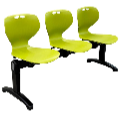
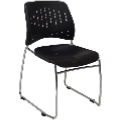
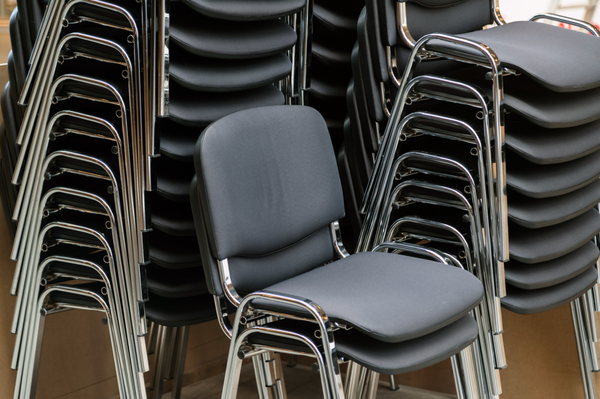
A stacking chair stores in a vertical column. The legs and frame are designed so one chair nests on top of another, with the upper chair's seat resting at the seat-back junction of the chair below. A column of commercial stacking chairs reaches 8 to 15 chairs high, depending on the model and the stack offset per unit.
Stack offset is the measurement that determines storage density. A chair with a 3-inch offset per unit stacks 20 chairs into about 5 feet of height. A chair with a 5-inch offset reaches the same height at 12 chairs. For rooms where ceiling height or storage space is a constraint, the stack offset number matters as much as the chair's footprint.
Most commercial stacking chairs work with a matching dolly that holds 20 to 40 chairs and rolls the entire column to a storage room. Without a dolly, moving stacked columns risks frame damage on the bottom chairs.
Folding chairs
A folding chair stores in a flat profile. The seat and back fold down against the legs, reducing the chair to a flat profile of 2 to 4 inches thick. Folding chairs lean against a wall, hang on a rack, or store in a rolling cart designed to hold 30 to 50 chairs in a single column.
Flat storage is the folding chair's primary advantage over a stacking chair. A cart of 40 folding chairs occupies the floor space of a single chair footprint. The same 40 stacking chairs in columns occupy 3 to 4 chair footprints plus maneuvering room around each column. For facilities with limited storage square footage, that difference is significant.
The trade-off is setup time. Deploying folding chairs requires unfolding and locking each chair one at a time. Stacking chairs come off the dolly ready to use with no setup step.
Durability and Commercial Use
Where stacking chairs hold up better
Commercial stacking chairs are built with a fixed, welded frame. There are no moving parts, no hinges, and no locking mechanisms. That construction makes them more resistant to mechanical failure under sustained commercial use. A conference room that turns over 3 times a day, 5 days a week, puts real stress on chair hardware. A stacking chair has none of the hardware that wears out.
For facilities that use the same chairs daily in training rooms, conference rooms, or break rooms, stacking chairs last longer under that pattern than folding chairs at the same price point.
Where folding chairs hold up better
Folding chairs are designed for portability and use cases that don't require daily deployment. They weigh less per chair than most commercial stacking chairs, which makes setup and breakdown faster for a single person. For event use, outdoor use, or any setting where chairs need to be transported by van or truck, the flat profile and lower weight of a folding chair are genuine advantages.
The hinge mechanism on a commercial-grade folding chair is rated for thousands of open-close cycles. A residential folding chair is not. In a commercial setting, specifying a chair with a commercial-grade double-hinge mechanism prevents the premature hinge failure that is the most common folding chair complaint in institutional environments.
Comfort and Seating Duration
Neither chair type is designed for extended seated work. Both are auxiliary seating for sessions where occupants move in and out over the course of a day.
For sessions under 2 hours, both types work adequately. For training sessions or seminars running 4 to 8 hours, seat padding and back support become meaningful. Upholstered stacking chairs with foam seat pads provide more comfort for long sessions than standard plastic-shell stacking chairs or basic metal folding chairs. Padded folding chairs fill the same role for venues that need the storage profile of a folding chair alongside better seating comfort.
Plastic shell stacking chairs and bare metal folding chairs are appropriate only for sessions under an hour. Using either for a full-day training program generates complaints and posture problems.
Weight Capacity
Commercial stacking chairs carry weight capacities from 250 to 880 pounds, depending on the model and frame construction. Commercial folding chairs range from 250 to 500 pounds. For most office environments, the standard 300-pound capacity covers the workforce adequately.
The BIFMA certification is the relevant specification for any chair going into sustained commercial use. A 400-pound capacity claim from an unbranded manufacturer carries no testing behind it. A BIFMA-certified chair at 400 pounds was tested by an independent lab at that load across tilt mechanism cycles, static load, and arm strength. For conference rooms, training rooms, or any space with high daily occupancy, the certification matters more than the number alone.
Which Is Right for Your Space
Choose stacking chairs if:
- The chairs will be used daily in a fixed location such as a conference room or training room
- Setup time is a factor and chairs need to go from storage to use without an unfolding step
- The space has ceiling height and floor space that accommodates stacked columns
- Durability under daily commercial use is the priority over storage compactness
- The chairs need to gang together in rows for auditorium or classroom seating arrangements
Choose folding chairs if:
- The chairs move between locations or transport in a vehicle
- Storage space is the binding constraint and flat-profile storage on a rack or cart is necessary
- The chairs are used for events rather than daily office sessions
- Outdoor use is part of the requirement
- Budget is the primary constraint and the chairs won't see daily heavy use
When you need both
Conference rooms that serve as both daily meeting spaces and occasional event venues often benefit from two separate chair inventories. Stacking chairs stay in the room for daily use. Folding chairs go into storage for event deployment. This avoids using daily-use chairs for high-turnover event setups where the wear pattern accelerates frame and hardware fatigue.
Frame Materials
Steel vs. aluminum
Commercial stacking chairs come in steel or aluminum frames. Steel frames are heavier and more resistant to bending under sustained load. Aluminum frames weigh 30 to 40 percent less per chair, which matters when moving stacked columns or deploying chairs for an event. For a chair that stays in one room and gets used daily, steel is the more durable option at a lower per-unit cost. For chairs that travel to multiple locations, aluminum reduces handling fatigue.
Folding chairs at the commercial level are almost all steel with a powder-coat finish. The weight difference between commercial folding chairs is smaller than in stacking chairs, ranging from 8 to 14 pounds per chair depending on the model.
Seat and back materials
Both chair types come in plastic shell, fabric upholstered, and vinyl upholstered configurations. Plastic shell is the lowest cost and highest storage density option. It's appropriate for break rooms, cafeterias, and any setting where session duration is under an hour.
Fabric upholstery adds comfort and is appropriate for conference rooms and training spaces with longer sessions. In environments that require regular sanitizing, vinyl is the right choice. Vinyl wipes clean without the moisture absorption that degrades fabric faster in high-contact environments such as healthcare waiting areas or government offices.
Storage Space Planning
Before ordering, calculate the storage requirement for the quantity needed.
For stacking chairs: divide the total chair count by the chairs per dolly (20 to 40 per unit), then multiply by the dolly footprint. A dolly holding 30 chairs measures about 22 by 22 inches. Twenty dollies require 20 dolly footprints plus aisle clearance for removal. Most facilities store dollies in a single row against a wall with a 36-inch aisle in front.
For folding chairs: a rolling storage cart holding 40 chairs measures about 24 by 24 inches and 60 inches tall. The cart rolls through a standard 36-inch doorway. For 100 chairs, 3 carts take about 18 square feet of floor space.
Confirm the storage room door width before ordering large quantities of either type. Some commercial dollies and carts require a 42-inch doorway to clear without tipping.
What to Confirm Before Ordering
Before placing a stacking or folding chair order, confirm with the vendor:
- Whether the chair is BIFMA certified and to what weight capacity
- The stack offset per chair and maximum stack height for stacking models
- Whether a matching dolly or cart is available and compatible with the specific model
- Whether ganging clips are available for stacking chairs that will be set up in rows
- The hinge mechanism type on folding chairs and whether it is rated for commercial use
- Whether the frame material is steel or aluminum and the per-chair weight
- Whether the chairs are in the vendor's warehouse or on a manufacturer lead time
Stacking and Folding Chairs at InStockChairs
InStockChairs stocks commercial-grade stacking chairs and folding chairs in multiple frame, seat, and capacity configurations. All inventory ships from the warehouse in Eden Prairie, Minnesota. Corporate and government buyers can purchase by purchase order. Free shipping applies to all orders in the 48 contiguous states.
For buyers choosing between the two types and uncertain which fits their space and use case, the customer service team can walk through the comparison based on your storage setup and session requirements.