
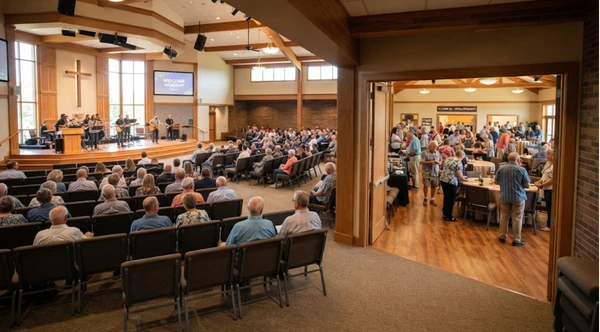
Church and Fellowship Hall Chairs: A Buying Guide for Facility Committees
Sep 25th 2026
Most churches buy chairs twice: once for the sanctuary, and again, a few years later, for everything the sanctuary doesn't cover. Fellowship halls, overflow rooms, and multipurpose spaces need seating that a volunteer crew can set up before service and clear out before the next event, often with no professional labor and a narrow window to do it.
That's a different design problem than sanctuary seating, and the two get shopped as separate purchases, for good reason.
Sanctuary Seating vs. Fellowship Hall Seating
Sanctuary chairs stay in place. They're chosen for comfort during a long service, often interlocked in rows to keep the seating arrangement fixed and orderly, and upholstered for the room's aesthetic.
Fellowship hall and multipurpose room chairs move every week. They need to stack high, roll or carry with one hand, and survive years of setup and teardown without the frame loosening or the upholstery tearing at the seams. A chair built for one job falls short at the other. Sanctuary chairs are heavy for a volunteer to stack fifteen high after a potluck. Lightweight stacking chairs don't hold up as the primary seat for an hour-long service.
What to Look for in Stacking and Interlocking Chairs
Stack height and storage
A stacking chair rated for 8 to 10 units per stack fits most storage closets and rolling carts. Chairs that only stack 4 or 5 high need double the floor space in storage, which matters in a building where the storage room also holds folding tables, AV equipment, and holiday decorations.
Interlocking hardware
Interlocking chairs connect to the chair beside them with a clip or hook, which keeps a row straight without anchoring it to the floor. This matters for rooms that host both a Sunday service and a Tuesday night event: the row holds its shape during use and comes apart in seconds for storage. Confirm the interlock connects from the side, not just the back, if the room uses curved or angled rows.
Frame gauge and weld quality
The failure point on a stacking chair under heavy use is almost always the weld where the legs meet the seat frame. A thicker steel gauge and a continuous weld hold up through years of stacking, transport on a dolly, and the occasional chair getting kicked or dropped during breakdown. Thin-gauge frames develop wobble within a couple of seasons of weekly use.
Padding and upholstery
A padded seat matters more than a padded back for a chair used during a seated meal or a longer meeting. Vinyl outperforms fabric for fellowship halls that host potlucks and coffee hours, since spills wipe off instead of soaking in. For sanctuary seating, where the main use is during services, fabric offers more comfort for the longer sit.
Dollies
A chair dolly turns a stack of 10 to 12 chairs into one unit a single volunteer can move. For any facility relying on volunteer labor for setup and teardown, a dolly rated for the specific chair model is worth the add-on cost. Confirm the dolly is sized for the chair's base dimensions before ordering; a dolly built for a different frame won't hold the stack in place.
Sizing the Order
Facility committees tend to undercount. A sanctuary that seats 300 on a Sunday often hosts 150 to 200 in the fellowship hall for a smaller event, plus a reserve for growth and for chairs that get retired from wear. A reasonable buffer is 10 to 15 percent above current attendance, split across a primary stacking model and a smaller reserve of a matching style for overflow.
Ordering in a single batch, rather than adding a few chairs each year as budget allows, keeps the frame color, fabric, and stack height consistent across the room. Mismatched chairs from different purchase years is one of the most common complaints facility committees raise after a few years of piecemeal buying.
Church and Fellowship Hall Seating at InStockChairs
InStockChairs carries stacking and interlocking chairs built for facilities that set up and break down their own seating, alongside a broader line of nesting and stackable meeting chairs for multipurpose rooms. Every chair ships from the company's own warehouse in Eden Prairie, Minnesota, with free shipping to all 48 contiguous states.
Facility committees ordering by purchase order or working within a budget approved months in advance can confirm exact inventory and lead time with the customer service team before the order goes in, so a large batch order arrives on the timeline the building committee needs.