
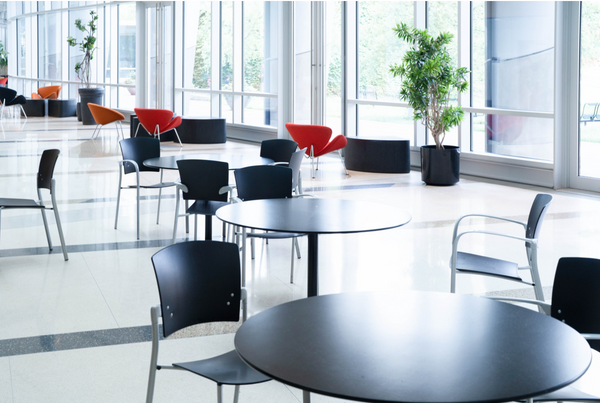
How to Choose Commercial Breakroom Chairs: What's Different from a Standard Office Chair
Jul 6th 2026
A breakroom chair and a task chair solve different problems. A task chair is built for one person sitting eight hours a day at a single workstation. A breakroom chair sees dozens of different people a day, food and drink spills, and shift-change traffic that never lets the seat cool down. Buying a task chair for a breakroom, or a cheap folding chair for the same job, both miss the mark.
Here is what separates breakroom seating from the rest of the commercial office chairs catalog, and what to look for before you order.
Why Breakroom Chairs Need a Different Spec
Breakroom seating gets more daily contact points than almost any other chair in a commercial building. A 50-person office might have five people sitting in the breakroom during any given hour, but over a full day that adds up to well over a hundred sit-down events on the same set of chairs.
That volume changes the priority order. Ergonomic adjustability, which matters most for a task chair, matters far less here. Durability, cleanability, and stackability move to the top of the list.
Seat Material: Cleanable Comes First
Breakroom chairs need to handle coffee spills, food residue, and daily wipe-downs without degrading. Fabric upholstery is the wrong choice here for the same reason it is wrong in a clinical setting: it absorbs liquid and holds odor.
- Vinyl or polyurethane seats: the standard choice for breakrooms. Wipes clean, resists staining, holds up to daily disinfecting
- Molded plastic seats: common on stack chairs, easy to clean, and holds up well in high-turnover cafeteria-style breakrooms
- Avoid fabric or mesh: both trap spills and are difficult to fully sanitize between shifts
If your breakroom doubles as a space for outside vendors, guests, or shift workers eating on staggered schedules, vinyl or molded plastic is the only practical choice. Fabric will not hold up.
Stackability: Storage and Flexibility
Breakrooms often double as meeting spaces, training rooms, or overflow seating during company events. Stackable chairs let you reconfigure the room fast and store extra seating without eating floor space.
- Standard stack height: most commercial stack chairs stack 6 to 10 high without damaging the frame or finish
- Dollies and carts: for breakrooms that regularly reconfigure, a rolling stack cart saves setup and breakdown time
- Non-stacking options: if the breakroom has a fixed table-and-chair layout with no reconfiguration need, a heavier non-stacking chair with a larger seat can be a better comfort trade-off
Match the stack decision to how the room gets used, not to a default assumption. A breakroom that never reconfigures does not need stackability as a top priority.
Weight Capacity for High-Rotation Use
Breakroom chairs are used by every employee in a building, not a single assigned user. That means the chair needs to accommodate the full range of body types on staff, not an average.
Set a 300 lb minimum weight capacity for standard breakroom chairs. For facilities with larger staff populations or industrial workforces, order a portion of the breakroom seating in a big and tall rating of 400 lbs or more so no employee is left without a chair that fits.
A breakroom is not the place to gamble on weight capacity. Every employee uses these chairs. Order enough capacity across the room that no one has to think twice about which seat to take.
Why BIFMA Matters Here Too
Breakroom chairs take more cumulative wear than almost any other seating category in a building, which makes commercial-grade construction essential, not optional. Chairs tested to meet or exceed ANSI/BIFMA standards have been evaluated for load capacity, fatigue resistance, and frame stability under repeated use.
A breakroom chair without that testing behind it tends to loosen at the joints and crack at the seat pan within a year of high-traffic use. InStockChairs carries breakroom and stack seating built to meet or exceed ANSI/BIFMA standards, evaluated by the team before it goes into inventory.
In-Stock Availability for Fast Turnaround
Breakroom furniture replacement is rarely planned months in advance. A chair breaks, a new hire wave requires more seating, or a renovation adds a second breakroom to the building. These purchases usually need to happen fast.
InStockChairs carries breakroom and stack chairs in its Minnesota warehouse, ready to ship. Free shipping to the 48 contiguous states. Purchase orders are accepted for facilities and procurement teams working through formal buying processes.
Breakroom Chair Spec Checklist
- Seat material: vinyl, polyurethane, or molded plastic
- Stackability matched to how the room gets used
- Weight capacity: 300 lb minimum, with big and tall options available in the room
- Frame built to meet or exceed ANSI/BIFMA standards
- Vendor with in-stock inventory for fast replacement or expansion