
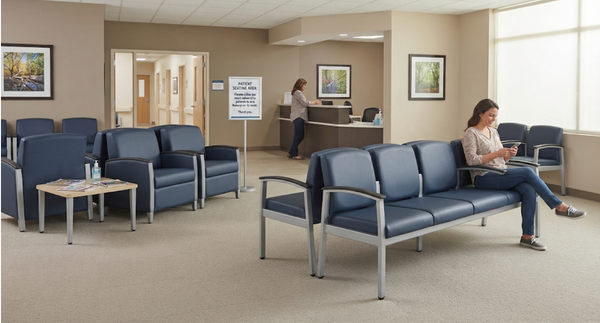
Patient-Facing Seating for Medical Offices: What Waiting Rooms Need That Staff Areas Don't
Sep 25th 2026
A medical office buys two kinds of chairs as a rule, and the two purchases seldom get planned together. Staff seating goes to front desk and administrative areas, chosen the way any office picks a task chair. Waiting room and exam area seating serves a different population, under different conditions, and the priorities shift with them.
Patients waiting to be seen include people recovering from surgery, managing chronic pain, using mobility aids, and arriving anxious about the visit itself. The seating in that room is doing more work than it looks like from a spec sheet.
Cleaning Requirements Come First
Medical waiting rooms and exam areas get cleaned between patients or at set intervals throughout the day, and the seating has to hold up to that schedule without degrading. Upholstered fabric absorbs the wipe-down solutions offices use and shows wear faster under that routine. Vinyl and specialty performance materials designed for healthcare settings hold up to repeated cleaning without cracking or discoloring over time.
Ask the vendor what cleaning agents the upholstery is rated for, and treat "antimicrobial" or "healthcare-grade" labeling as a starting point for that conversation, not a substitute for it. A material that looks similar to another on a color swatch can react in a different way than expected to a bleach-based or quaternary disinfectant, and the wrong pairing shows up as visible damage within months.
Seat Width and Weight Capacity
A waiting room serves a general adult population, which means seat width matters as much as weight rating. A row of chairs built to a standard 18-inch seat width creates a real problem for patients who don't fit in comfort, and it shows in how a waiting room gets used in practice: people standing rather than choosing a seat that doesn't fit.
Mixing standard-width seating with a portion of wider, higher-capacity chairs, often rated to 400 or 500 pounds, gives every patient a seat that works without singling anyone out. This matters most in specialties that see a broad range of patients: primary care, orthopedics, and physical therapy in particular.
Arms That Support Standing
Armrests do more in a medical waiting room than in a standard office. A patient managing joint pain, recovering from a procedure, or just older uses the armrests to push up to standing, not just to rest their elbows. Chairs without arms, or with arms positioned too far forward or back to brace against, make that transition harder than it needs to be.
For exam room and procedure area seating, chair height that lines up with an easy stand matters more than in a general waiting room, where patients have more time and less urgency.
Spacing and Layout
Wider aisles and more space between seats accommodate wheelchairs, walkers, and companions accompanying a patient. A waiting room laid out at maximum seat density looks efficient on paper and creates a bottleneck in practice, most of all during peak hours when a mobility device needs to pass through the row.
Beam and bench-style seating, which mounts individual seats to a shared frame, keeps a row from drifting out of alignment over months of heavy use, which matters for maintaining that spacing without staff resetting the room throughout the day.
Color and Material Beyond Function
Waiting rooms are often the first impression a patient has of a practice, and the room's finish matters for that reason alongside the functional requirements above. A practice that wants a calmer, less clinical feel can specify upholstery colors and finishes that read less institutional, without giving up the cleanable surface a medical setting requires. Vendors carrying a range of colors in the same cleanable material make that possible without a tradeoff.
Ordering for a Multi-Room Practice
Larger practices often furnish a main waiting room, a pediatric or specialty waiting area, and individual exam rooms in the same order. Working from a single vendor for all three keeps the color and material consistent across areas patients move through in a single visit, and simplifies the reorder when a chair needs replacing years later.
Patient-Facing Seating at InStockChairs
InStockChairs stocks medical office and healthcare seating built for cleanable surfaces and higher weight capacities, including antimicrobial healthcare vinyl, in its own warehouse in Eden Prairie, Minnesota. The customer service team can confirm what's in stock and answer material questions before an order ships.